



Table of Contents
An accounting partner is waiting on client files before a filing deadline, but the portal access request is sitting between support queues. At the same time, a security alert needs review, invoices need approval, and no one is fully sure who owns the next decision.
That’s why IT managed services challenges show up in daily work, not just in technology meetings. When support and cybersecurity run in separate lanes, tickets slow down, risk gets harder to read, and business interruption becomes easier to miss.
Rhianna Dahm, CRO at Level 4 MSSP Corp, notes: “Treat every access ticket, backup alert, and patch decision as a business workflow issue, because the delay usually lands on clients, invoices, or audits first.”
Why IT Managed Services Challenges Slow Operational Momentum
The friction often appears before anyone names the root issue. A delayed login approval turns into a missed campaign launch, a patch window interrupts billable work, or an audit request sends people searching across inboxes, portals, and ticket notes.
-
Access requests pile up: Marketing teams wait on application permissions, accounting staff pause client portal work, and customer responses sit while approvals move through unclear paths.
-
Patch timing gets messy: Maintenance competes with production schedules, so teams postpone updates and carry avoidable risk into the next workday.
-
Security tickets lack context: An alert on an executive laptop needs business priority, especially when customer data or payment files are involved.
-
Backups feel uncertain: Recovery confidence matters when shared folders, invoices, client records, and core applications are needed to keep work moving.
Specific Domain Scenario: In an accounting firm, tax files may move through a client portal while audit requests arrive from a separate system. If an access approval stalls, a reviewer loses time. If a staff member accidentally deletes a client document, recovery needs to be clear, tested, and tied to the filing workflow.
The next step is to connect routine support decisions with security and continuity decisions, so small issues don’t become deadline problems.
Access management, system patching, backup recovery, compliance evidence.
|
Operational Signal |
Likely Accountability Gap |
Embedded Security Response |
Business Outcome to Track |
|---|---|---|---|
|
New CRM user waits three days for role-based access before a campaign launch |
Marketing manager, help desk, and identity admin use separate approval paths |
Preapproved access templates in Microsoft Entra ID with manager signoff and conditional access checks |
Average access fulfillment time for Salesforce, HubSpot, and shared mailbox requests |
|
Quarter-end patch window is postponed because finance needs uninterrupted ERP access |
Infrastructure owner and controller do not share a maintenance risk calendar |
Risk-ranked patch schedule tied to Sage Intacct, QuickBooks, or NetSuite usage periods |
Percentage of critical patches applied within SLA without unplanned downtime |
|
MDR alert flags impossible travel for a partner account during client file review |
Security analyst lacks context on whether the login supports an active deadline |
Ticket enrichment with user role, client matter, device trust status, and escalation owner |
Mean time to approve, contain, or dismiss identity-related alerts |
|
Staff member deletes client tax workpapers from SharePoint before an audit request |
Backup ownership is unclear between application admin and IT support queue |
Documented restore runbook with retention policy validation and quarterly recovery test |
Recovery time for SharePoint, OneDrive, email, and practice management documents |
Where Managed Services Challenges Show Up In Everyday Work
A normal workday gets messy when support, security, and compliance responsibilities sit with separate providers or internal queues. Managed services challenges show up as a billing ticket without urgency, a security alert without business context, or a recovery question no one can answer quickly.
-
Tickets lose business context
A printer issue is routine until it blocks invoice processing before approvals close. One accountable service model keeps the ticket tied to the workflow, not just the device.
-
Access approvals move slowly
Password management and identity support help new hires, contractors, and project teams get safer access without unclear approval chains. That keeps campaigns, client work, and onboarding from stalling.
-
Security alerts compete with work
SIEM, MDR, XDR, EDR, and ATP turn alert activity into faster detection, fewer disruptions, and lower risk to customer data. The business value is knowing which alert needs action first.
-
Maintenance disrupts production schedules
System patching and maintenance protect endpoints and applications while respecting work hours, payroll runs, and client delivery windows. Cleaner change planning reduces avoidable downtime.
-
Recovery plans stay untested
Immutable backups and disaster recovery support continuity when files, cloud workloads, or line-of-business systems become unavailable. Broad attack-surface visibility, the idea behind our True Level 4 Security Framework, helps leaders make better recovery decisions.
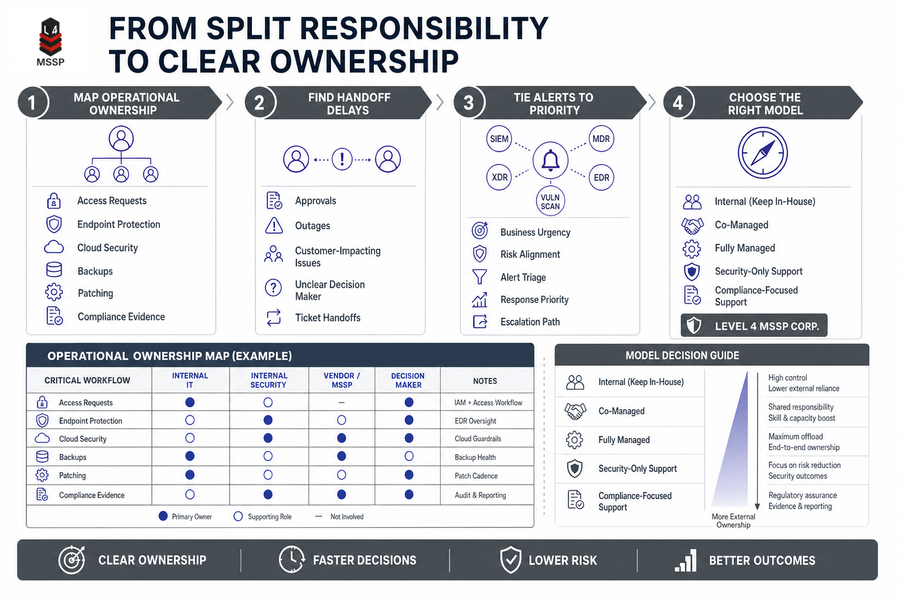
How IT Managed Services Provider Challenges Affect Accountability
Split responsibility slows root cause analysis, ticket escalation, and risk decisions because no single partner owns both uptime and risk reduction. IT managed services provider challenges become visible when a cloud access issue affects a client deadline, while endpoint protection, compliance evidence, and backup status sit in different conversations.
Changing support models takes care. Teams already have trusted tools, vendor contracts, and internal approval paths that can’t be ignored. The goal isn’t to blame those structures. It’s to make ownership clearer around the systems and data that keep the business operating.
-
Map operational ownership: Document who owns access requests, endpoint protection, cloud security, backups, patching, and compliance evidence for each critical workflow.
-
Find handoff delays: Identify where tickets move between teams without a clear decision maker, especially for approvals, outages, and customer-impacting issues.
-
Tie alerts to priority: Review whether SIEM, MDR, XDR, EDR, and vulnerability scanning alerts connect to business urgency and risk decisions.
-
Choose the right model: Decide what stays with internal staff and what should be co-managed, fully managed, security-only, or compliance-focused support with us.
Related IT Services Insights
Business Risks Behind Managed Services Providers Challenges
Unresolved service gaps do not stay inside the IT queue. Managed services providers challenges affect revenue timing, client trust, employee productivity, audit readiness, and enterprise value when access, security, backups, and support decisions are handled in disconnected lanes.
-
Revenue work gets delayed
Access, endpoint, network, or cloud issues can slow billing, client delivery, campaign approvals, and proposal reviews. Proactive monitoring and integrated support help keep those revenue workflows from waiting on preventable tickets.
-
Audit evidence gets scattered
Compliance and regulatory support bring structure to logs, patch records, access reviews, and security documentation. Cleaner evidence collection reduces last-minute pressure when auditors ask for proof.
-
Client confidence takes pressure
Secure systems, password management, Security Awareness Training, and rapid issue resolution support stronger trust around customer and client data. That matters when clients ask how files, portals, and user access are protected.
-
Recovery expectations stay unclear
Immutable backups, disaster recovery, and business continuity planning give leadership a clearer path when files, systems, or cloud workloads become unavailable. The business result is faster operational recovery and better decisions during a disruption.
-
Growth strains existing processes
Adding users, locations, applications, and cloud environments creates more approvals, endpoints, and risk decisions. Integrated IT and cybersecurity support helps teams scale without carrying unmanaged access, unpatched systems, or unclear recovery plans into the next stage of growth.
Turn IT Friction Into Clear Action
Managed services challenges slow tickets, security decisions, and daily work. See how Level 4 MSSP Corp helps create clearer accountability.
Solving Managed IT Services Challenges With One Accountable Partner
Secure, well-run IT protects the work your teams already care about, including client files, access approvals, invoices, audit evidence, backups, and the systems that support growth. Through MSSP One, we unify managed IT and cybersecurity into one accountable service model, which means fewer service gaps, faster issue resolution, stronger compliance readiness, and more confidence as you scale.
If you already have an internal IT team, we support security-only, compliance-focused, or co-managed needs without replacing established operations. Contact Level 4 MSSP Corp for a practical conversation about where unified support would remove friction, including the access request, security alert, or backup question that’s slowing work today.